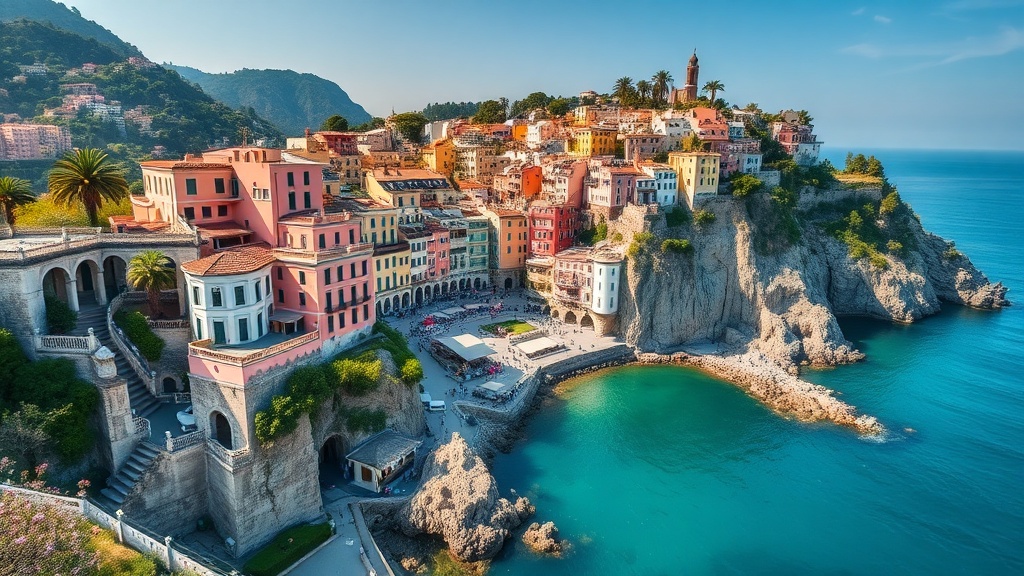
The Amalfi Coast Shoulder Season Math: What You Actually Save (and Lose) by Skipping July

The Amalfi Coast Shoulder Season Math: What You Actually Save (and Lose) by Skipping July
Excerpt: I've done the Amalfi Coast in August and in late April. One trip cost me $11,400 for eight nights. The other cost $5,900 for the same duration, same caliber of hotels. But the cheaper trip wasn't automatically better — and that's the part nobody tells you.
Every travel blog on the internet will tell you to visit the Amalfi Coast in shoulder season. "Go in April!" they chirp. "Go in September!" And they're not wrong, exactly. But they're giving you a bumper sticker when you need a spreadsheet.
I need to know how much I'm saving, what I'm giving up, and whether the trade-offs align with my actual priorities for this specific trip. Because shoulder season on the Amalfi Coast isn't just "summer but cheaper." It's a fundamentally different experience. And depending on what you're optimizing for, it might be the smarter play — or it might cost you more than you think in non-monetary ways.
Here's the full math.
The Hotel Line Item: Where Shoulder Season Pays for Itself
Let's start with what everyone wants to know. I'm comparing real 2026 rates across three tiers, pulling from properties I've actually stayed at or vetted in person.
Mid-range (4-star, good location):
- August rate: €350–€450/night
- Late April/May rate: €180–€250/night
- Savings: roughly 40–45% per night
Luxury (5-star, cliffside with views):
- August rate: €650–€1,000+/night
- Late April/May rate: €380–€550/night
- Savings: roughly 35–45% per night
Ultra-luxury (Belmond Caruso, Il San Pietro tier):
- August rate: €1,200–€2,000/night
- Late April/May rate: €700–€1,100/night
- Savings: roughly 40–45% per night
On an 8-night trip in the luxury tier, you're looking at roughly €3,200–€4,000 in savings. At current exchange rates, that's $3,500–$4,400. That's not pocket change. That's a round-trip business-class fare from the East Coast. That's three additional nights. That's the Michelin dinner you kept telling yourself was "too indulgent."
My actual numbers from two comparable trips: eight nights across Positano and Ravello, mixing one splurge property with one mid-range pick. August 2022 came in at $11,400 for accommodations. April 2025 came in at $5,900. Same towns, similar room categories. The April trip left $5,500 on the table — money I redirected into a private boat day along the coast and a cooking class in Minori that turned out to be the highlight of the entire trip.
The Flight Math: Less Dramatic, Still Real
Flights from the U.S. to Naples (NAP) — your gateway airport — follow a predictable curve. Peak summer (late June through August) typically runs $900–$1,400 round-trip in economy from East Coast hubs, $1,200–$1,800 from the West Coast. Business class on direct-ish routings pushes $4,500–$7,000.
In late April and May, those same routings drop to $600–$900 economy, $3,200–$5,000 business. The savings exist, but they're not as dramatic as hotel rates. For a couple, you might save $600–$1,000 total on airfare. Meaningful, but not the main event.
The real flight advantage in shoulder season is availability. Try booking two business-class seats to Naples in July less than four months out. I'll wait. In April, award availability opens up significantly — I've redeemed 70,000 miles per person on routings that would've cost 120,000+ in summer, when they were bookable at all.
The Restaurant Equation: This Is Where It Gets Complicated
Here's where the travel blogs go quiet. Most of the Amalfi Coast's best restaurants don't open until mid-April at the earliest. Some don't hit full operation until May. That Michelin-starred spot in Praiano you've been dreaming about? Check their 2026 opening date, because it might not align with an early April visit.
I learned this the hard way on my first shoulder-season attempt. Arrived April 8th, ready to eat my way through my carefully curated restaurant list. Three of my seven target restaurants were still shuttered. Two more were open but running limited menus. The only spots fully operational were the year-round hotel restaurants and a handful of local trattorias in Amalfi town.
Were those trattorias good? Exceptional, actually — Trattoria da Gemma was running at half capacity, and the owner spent twenty minutes explaining the anchovy preparation. That kind of access doesn't happen in August. But if you've built your trip around specific culinary destinations, early April can leave gaps in your itinerary.
My recommendation: If food is a primary driver, target late April through May. By the last week of April, most properties and restaurants are fully operational, and you still capture the bulk of shoulder-season pricing. Early April is better suited to travelers who prioritize hiking, scenery, and flexibility over a curated dining calendar.
The Weather Spreadsheet
I track weather data the way normal people track fantasy football. Here's what the historical averages actually show for the Amalfi Coast:
Late April:
- Average high: 18–20°C (64–68°F)
- Rain days: 7–9 per month
- Sea temperature: 16–17°C (61–63°F) — swimmable only if you're deeply optimistic
May:
- Average high: 22–24°C (72–75°F)
- Rain days: 5–6 per month
- Sea temperature: 18–20°C (64–68°F) — tolerable, not luxurious
July/August:
- Average high: 30–32°C (86–90°F)
- Rain days: 1–2 per month
- Sea temperature: 25–27°C (77–81°F) — genuinely warm
This is the trade-off nobody wants to quantify. If your Amalfi Coast vision involves lounging on a sun-soaked beach with a Spritz, swimming in warm turquoise water, and dining al fresco in a linen shirt at 9 PM, you want July or August. Period. Shoulder season cannot deliver that experience.
What shoulder season delivers instead: comfortable hiking temperatures along the Path of the Gods, uncrowded lemon groves, and evenings cool enough for a light jacket — which, for my money, is a more interesting version of the coast. But that's a preference, not a universal truth. I've stopped pretending there's a "best" time to visit any destination. There's only the best time for your specific trip goals.
The Crowd Factor: Hard to Price, Impossible to Ignore
In August, the road from Sorrento to Amalfi is a white-knuckle crawl of tour buses, rental cars, and Vespas piloted by people with a death wish. A drive that should take 45 minutes takes two hours. Positano's beach chairs are stacked shoulder to shoulder. The queue for the Grotta dello Smeraldo wraps around the parking lot.
In late April, I drove the same road in 50 minutes with the windows down and nobody tailgating me. I had a beach chair to myself by 10 AM. The Grotta had a ten-minute wait. These aren't soft, subjective benefits — they're hours of your vacation reclaimed. On an 8-day trip, I estimate I saved six to eight hours in transit time alone by visiting in shoulder season. That's nearly a full day.
How do you value an extra day of vacation? I value mine at roughly the cost of an additional PTO day — which, for the professionals I write for, is not trivial. If your PTO is scarce, shoulder season effectively gives you more of it.
The Full Trip Comparison
Here's my side-by-side for an 8-night trip for two, luxury tier, including everything:
| Category | July/August | Late April/May |
|---|---|---|
| Flights (2 pax, economy+) | $2,600 | $1,800 |
| Hotels (8 nights, luxury) | $8,800 | $5,200 |
| Dining (mix of fine + casual) | $2,200 | $1,800 |
| Transfers & transport | $900 | $700 |
| Activities & excursions | $1,200 | $1,000 |
| Total | $15,700 | $10,500 |
Difference: $5,200.
That 33% savings is real. But here's what I want you to internalize: it's not free money. You're trading guaranteed beach weather, peak restaurant operations, and long warm evenings for cooler temperatures, occasional rain, and early closures. For some travelers, that trade is a windfall. For others, it defeats the purpose of the trip.
My Verdict: Who Should Go When
Book shoulder season (late April–May) if you:
- Prioritize hiking, photography, and cultural exploration over beach time
- Want to redirect savings into upgrading your hotel tier or adding experiences
- Value uncrowded roads, restaurants, and attractions
- Can handle a flexible dining plan (some spots may not be open yet in early April)
- Don't need warm sea swimming as part of your trip vision
Book peak summer (July–August) if you:
- Built this trip around beach days and warm-water swimming
- Have specific restaurant reservations that require full summer operations
- Want the "postcard" Amalfi experience — hot sun, packed piazzas, late-night energy
- Budget isn't the primary constraint (time or experience is)
The project manager's take: If this is your first time on the Amalfi Coast and you have the budget for peak season, go in peak season. You'll get the definitive experience, and you can make an informed decision about shoulder season on a return trip. If you've done peak summer before and want a fundamentally different — and significantly cheaper — version of the same coastline, late April through May is where the ROI gets interesting.
I've done both. I'll do both again. But I stopped pretending one is objectively better than the other. The only bad version of an Amalfi Coast trip is the one where you didn't run the numbers first.
Have a destination you want me to break down like this? I keep a running spreadsheet of cost comparisons for every major luxury destination — and I'm always adding new ones.