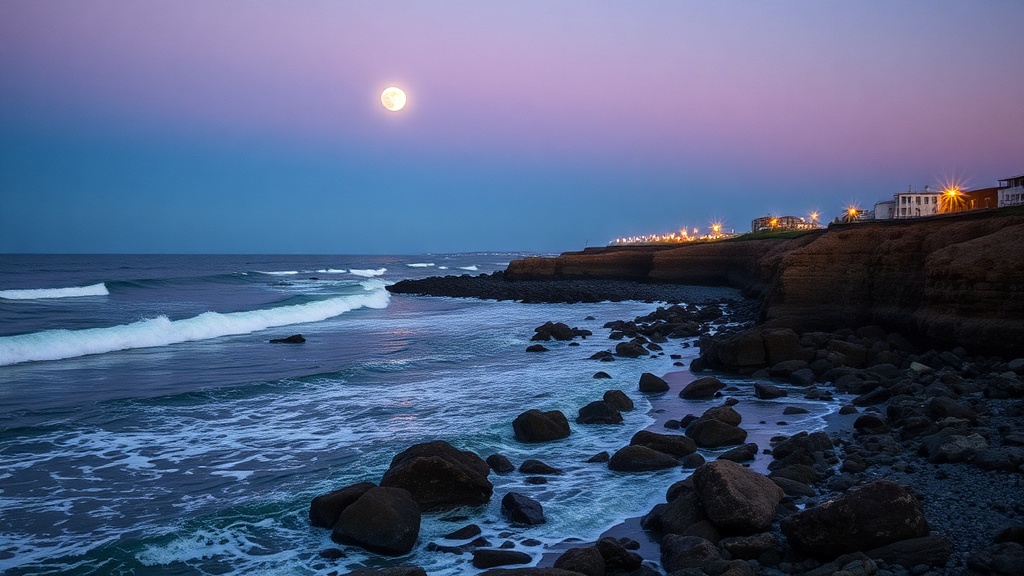
Lunar Cycles and Coastal Rhythms: Navigating Tide-Dependent Travel

Have you ever arrived at a pristine, white-sand beach in the Maldives only to find a muddy, low-tide expanse of seagrass and exposed sandbars instead of the turquoise lagoon you saw in the brochure?
This is the fundamental disconnect between "vacation dreaming" and "vacation logistics." Most travelers plan their trips around calendar dates or school breaks, but they fail to account for the celestial mechanics that dictate the physical reality of their destination. If your itinerary involves coastal activities—snorkeling, beach lounging, or boat excursions—the lunar cycle is just as critical to your ROI as your flight class or hotel rating. A high-end resort can offer a world-class experience, but if the tide is out for six hours during your only window of free time, your "luxury beach day" becomes a lesson in frustration.
To get the most out of your coastal investment, you must understand the relationship between the moon, the sun, and the water. This isn't just trivia; it is a strategic requirement for anyone who values precision in their travel planning. We are going to break down the mechanics of tidal cycles, how to use specific tools to predict them, and how to align your high-cost activities with the optimal water levels.
The Mechanics of the Tide: Spring vs. Neap
The most significant variable in coastal travel is the distinction between Spring Tides and Neap Tides. Despite the name, "Spring Tides" have nothing to do with the season. They occur during the New Moon and the Full Moon phases, when the Earth, Moon, and Sun align. This alignment exerts a combined gravitational pull, resulting in the most extreme tidal ranges: exceptionally high highs and exceptionally low lows.
The ROI Impact: If you are booking a trip to a destination known for its dramatic water features—such as the limestone cliffs of Krabi, Thailand, or the turquoise lagoons of Bora Bora—you need to decide which extreme serves your goals. If you want to walk between sandbars or explore tide pools, target the Full or New Moon phases. If you want deep, stable water for swimming right up to the shore, you may want to avoid these extremes.
Conversely, Neap Tides occur during the first and third quarters of the lunar cycle (the quarter moons). During this time, the gravitational forces of the sun and moon are perpendicular, partially canceling each other out. This results in much smaller differences between high and low tide. The water levels remain relatively stable, which is ideal for consistent swimming conditions, but you lose the dramatic scenery of high-volume water movement.
Strategic Activity Alignment: Matching the Tide to the Task
A common mistake is treating the beach as a static environment. In reality, the beach is a moving target. To maximize your time, you must categorize your planned activities by their "tidal dependency."
- High-Tide Dependent Activities: Snorkeling near coral reefs, kayaking through narrow sea caves (like those in Ha Long Bay), and certain motorized water sports. If you attempt to kayak through a sea cave at low tide, you risk scraping your hull or being unable to enter the cave entirely.
- Low-Tide Dependent Activities: Walking long distances on sandbars, exploring tidal pools, beachcombing, and photography of coastal rock formations.
- Tide-Neutral Activities: Sunbathing on elevated beach areas, poolside lounging, and dining at beach clubs.
Let’s look at a real-world example: The Amalfi Coast. If you are planning a private boat charter to explore the Grotta dello Smeraldo (Emerald Grotto), your experience is entirely dictated by the tide. At low tide, the entrance may be too shallow for a vessel to approach, and the light refraction that creates the "emerald" effect is significantly diminished. A professional planner would check the Tide Table for the specific port of Amalfi to ensure the charter is scheduled during a high-water window.
The Essential Toolkit: How to Predict Your Coastal Reality
You cannot rely on "feeling" the tide. You need data. Before you finalize your booking, you should integrate tidal forecasting into your planning spreadsheet. Here are the specific tools and methods I recommend for high-precision travel planning:
- Tide Table Apps: Download apps like Tide Forecast or Tides Near Me. These provide real-time data and, more importantly, long-range forecasts. When researching a destination, look for the "monthly view" to see the pattern of high and low tides over a 30-day period.
- NOAA Tides and Currents: If your destination is in the United States (such as the Florida Keys or the Pacific Northwest), the National Oceanic and Atmospheric Administration (NOAA) provides the gold standard of data. Their predictive models are highly accurate and essential for any water-based excursion.
- Local Port Authority Websites: For international travel, especially in regions like the Mediterranean or Southeast Asia, local maritime or port authority websites often provide the most accurate local data, which can be more precise than generic global apps.
When you are reviewing your itinerary, create a "Tidal Window" column. If you have a scheduled snorkeling excursion in the Seychelles, don't just write "10:00 AM." Write "10:00 AM (High Tide Window)." This forces you to cross-reference your activity with the predicted water level.
The Hidden Cost of Ignoring the Moon
Ignoring the lunar cycle can lead to "invisible" costs—both financial and emotional. For example, many luxury resorts offer "Sandbar Lunches" or "Private Island Picnics." If you book this during a heavy Spring Tide, the sandbar might be completely submerged, leaving you eating on a tiny, unstable patch of sand. If you book it during a low tide, you might find yourself walking through knee-deep mud or seaweed to reach your destination.
Furthermore, consider the impact on your circadian rhythm and biological energy. The increased light and movement of water during Full Moon cycles can affect sleep patterns and environmental noise levels. Just as you might look for ways to align your space with your circadian rhythm at home, you should consider how the environmental shifts of a coastal destination will impact your rest. A high-tide environment is often more "active" and noisy due to the crashing of waves, whereas a low-tide environment can be significantly more serene and quiet.
Case Study: The Mediterranean vs. The Indo-Pacific
It is vital to note that tidal ranges vary wildly by geography. This is a critical distinction for your planning.
The Mediterranean Sea: The Mediterranean is "micro-tidal." The difference between high and low tide is often negligible (sometimes only a few inches). If you are planning a trip to Santorini or the French Riviera, you can largely ignore the tide. Your primary concern there will be the wind and swell, not the water level. Investing heavy research time into tidal charts for the Mediterranean is a poor use of your time.
The Indo-Pacific and Atlantic Coasts: In contrast, destinations like Bali, the Maldives, or the Atlantic coast of Portugal experience much more dramatic tidal shifts. In these regions, the tide is a dominant force. A 3-meter difference in water level is not an exaggeration. In these locations, failing to check the tide isn't just a minor oversight; it is a fundamental failure in logistics that can render your expensive excursions impossible.
Final Checklist for Tide-Dependent Travel
Before you hit "confirm" on that high-value excursion, run through this professional-grade checklist:
- Identify the Amplitude: Is this a high-amplitude region (like the Atlantic or parts of Asia) or a low-amplitude region (like the Mediterranean)?
- Check the Lunar Phase: Am I traveling during a Full Moon or New Moon? If so, expect extreme highs and lows.
- Cross-Reference the Activity: Does my activity require deep water (high tide) or exposed land (low tide)?
- Verify the Tool: Have I checked a reputable source like NOAA or a local maritime authority, rather than just a general weather app?
- Build in a Buffer: If an excursion is tide-dependent, have I scheduled it with a 2-hour window around the peak tide to account for any local variations?
Travel planning is about mitigating variables. By accounting for the lunar cycle and the resulting coastal rhythms, you move from being a passive consumer of a vacation to a strategic architect of an experience. Don't leave your view to chance; plan for the tide.