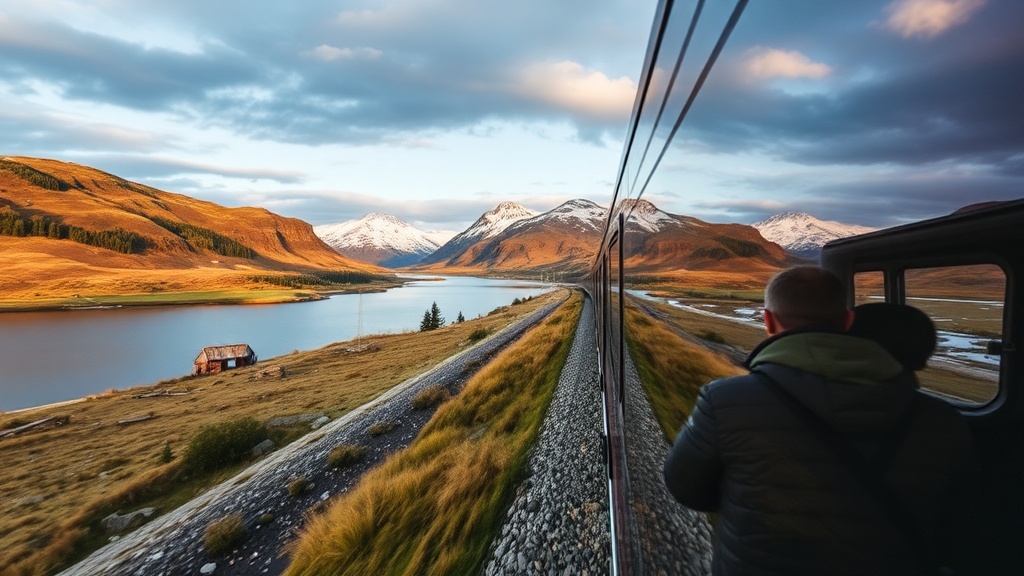
Why You Should Take a Slow Train Journey Through Scandinavia

The Efficiency of Slow Travel
Approximately 80% of travelers report feeling "travel burnout" after a high-intensity itinerary involving multiple short-haul flights and constant airport transfers. While the instinct for a high-achieving professional is to maximize destinations by flying between hubs, the most efficient way to actually experience Northern Europe is via the Scandinavian rail network. This guide breaks down why a slow train journey through Norway, Sweden, and Denmark provides a higher return on your time and mental energy than traditional air travel, focusing on logistical precision and actual value.
A rail-based itinerary allows you to treat the transit itself as a destination rather than a dead interval between activities. Instead of losing four hours to security, boarding, and taxi transfers, you spend that time in a controlled environment with reliable Wi-Fi, predictable seating, and unobstructed views. This post outlines the strategic advantages of the Scandinavian rail system, the specific routes that offer the best visual ROI, and how to manage the logistics of a multi-country journey.
The Logistical Advantages of Rail Over Air
When planning a multi-city European trip, the "flight-hopping" method often looks cheaper on paper but fails once you account for the hidden costs of time and cognitive load. In Scandinavia, the rail infrastructure is highly integrated, meaning you can move from Copenhagen to Oslo or Stockholm with minimal friction.
Predictability and Time Management
Airlines are subject to frequent delays and baggage handling issues that can derail a tight schedule. In contrast, the SJ (Swedish Railways) and Vy (Norwegian State Railways) operate on highly disciplined schedules. If you book a high-speed X2000 train in Sweden, you are looking at a near-constant velocity that allows you to plan your arrival in a city down to the minute. This predictability is essential for professionals who need to maintain a baseline of productivity or strict downtime.
The Productivity Factor
Unlike a cramped airplane seat, Scandinavian train carriages—particularly in First Class or Business Class—are designed for extended occupancy. You will find ample desk space, power outlets at every seat, and stable Wi-Fi. If you need to clear your inbox or finalize a brief before your next destination, a four-hour train ride is a viable workspace. This transforms "lost time" into "productive time," a concept that is often overlooked in traditional vacation planning.
Cost-Benefit Analysis of Luggage
One of the most significant hidden costs of European travel is the baggage fees associated with low-cost carriers like Norwegian Air or SAS. When traveling by train, there are no weight limits for standard suitcases, and you can move freely between the carriage and the luggage racks. If you are traveling with more than a single carry-on, the rail system eliminates the logistical headache of checking bags and waiting at carousels, which can save you up to 90 minutes per transit leg.
Primary Routes and Visual ROI
Not all train journeys are created equal. To get the best value for your time, you should prioritize routes that offer significant geographical changes. A flat journey through the Swedish plains is efficient, but a journey through the Norwegian fjords is an experience.
The Bergen Line (Bergensbanen), Norway
This is arguably the most high-value rail journey in Europe. The route connects Oslo to Bergen and traverses the Hardangervidda mountain plateau. The visual ROI here is massive: you transition from the urban density of Oslo to high-altitude mountain landscapes and deep valleys. The journey takes approximately seven hours, but the scenery is constant and high-impact. It is a superior alternative to a short flight because the transition in landscape is gradual and immersive, rather than a jarring jump from one climate to another.
The Stockholm to Gothenburg Corridor, Sweden
If your goal is a mix of urban exploration and coastal scenery, this route is the most efficient. The high-speed SJ trains make this trip highly predictable. This is a "utility route"—it is fast, reliable, and serves as an excellent way to move between Sweden's two most important economic hubs while seeing the Swedish countryside. It is the ideal leg for travelers who want to move quickly but prefer the comfort of a seated environment over an airport terminal.
The Copenhagen to Stockholm Connection
This route is the backbone of Scandinavian connectivity. It is a long-distance haul, but it is the most effective way to bridge the gap between Denmark and Sweden. By taking the train, you avoid the complexity of flying out of Copenhagen Airport (CPH), which, while efficient, still requires significant transit time from the city center. Using the rail system keeps your movement centralized within the city-to-city transit corridors.
Practical Execution: Booking and Onboard Amenities
To execute this successfully, you cannot rely on spontaneous booking. The Scandinavian rail system operates on a tiered pricing model similar to airlines; the earlier you book, the higher your margin of profit.
Booking Strategy
- Book via Official Channels: Always book directly through SJ.se (Sweden), Vy.no (Norway), or DSB.dk (Denmark). Third-party booking sites often add service fees and can be slower to communicate platform changes or delays.
- Prioritize Seat Reservations: In Scandinavia, a ticket does not always guarantee a seat. For journeys longer than two hours, a seat reservation is non-negotiable. If you are traveling for work or want to ensure a window seat for the scenery, book this at the same time as your ticket.
- Class Selection: If your budget allows, upgrade to First Class. The marginal cost increase is often worth it for the increased legroom, complimentary coffee/tea, and a significantly quieter environment.
Managing Connectivity and Tech
While most major trains offer Wi-Fi, it is not always optimized for high-bandwidth tasks like video conferencing. If you intend to use the journey as a workspace, treat it as a secondary connection. For example, if you are moving between countries and need to ensure you stay connected for a scheduled call, you should know why you should always buy a local SIM card to provide a reliable mobile hotspot backup. This ensures that a momentary lapse in train Wi-Fi does not result in a missed professional commitment.
Packing for the Rail Environment
Rail travel requires a different packing mindset than air travel. You do not need to worry about liquid restrictions or strict carry-on dimensions, but you do need to consider mobility. You will be lifting your own bags onto overhead racks or into luggage areas at the end of the carriage. I recommend a high-quality, four-wheel spinner suitcase for ease of movement through stations, paired with a streamlined backpack for your electronics and essentials. For more specific advice on optimizing your gear, see my guide on how to pack a carry-on for a two-week trip.
The Verdict: Is It Worth It?
The "slow" in slow travel is a misnomer; it is actually about the quality of the transit. If you value time-certainty, the ability to work while moving, and the avoidance of the high-stress environment of modern airports, the Scandinavian rail system is the superior choice.
The ROI Breakdown:
- Time: You save significant hours by avoiding airport security and ground transportation to/from remote terminals.
- Mental Energy: You replace the "hurry up and wait" fatigue of flying with a predictable, seated experience.
- Experience: You gain a visual understanding of the geography that a flight simply cannot provide.
For the professional who demands efficiency and high-quality experiences, a Scandinavian rail journey is not a compromise—it is a strategic optimization of your vacation time.